


 about this topic
Book of Mormon Origins
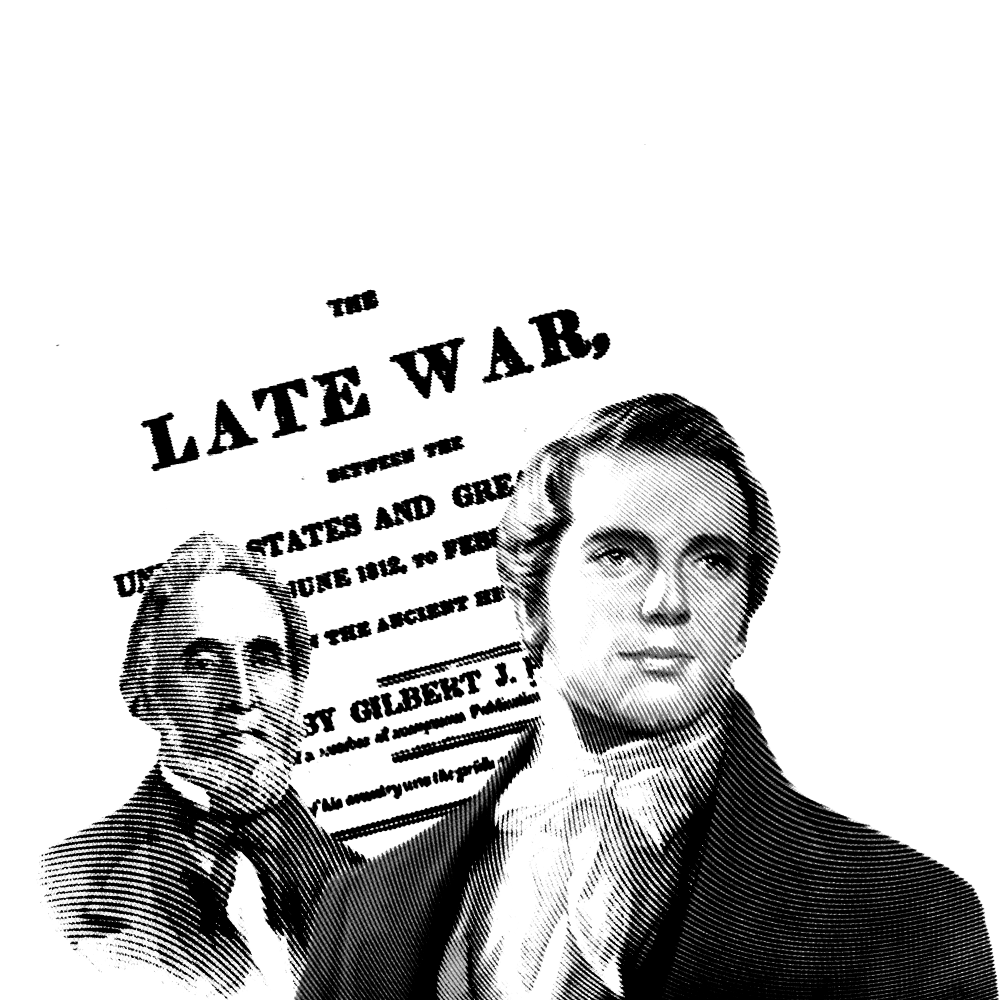
Did Joseph Smith write the Book of Mormon? Did he plagiarize from other books to write it? What is the Spaulding manuscript? This article discusses many of the popular theories regarding how the Book of Mormon was created.
Where did the Book of Mormon come from?
Joseph Smith[BIO] said he translated the Book of Mormon by the gift and power of God from ancient gold plates that he was led to by an angel named Moroni.[BIO][1] Various alternative theories have been proposed over the years.
Timeline of Alternative Theories of Book of Mormon Origins
19th Century - During Joseph Smith’s Lifetime
June 26, 1829
August 11, 1829
February 20, 1830
March 1830
November 25, 1830
February 10, 1831
February 15, 1831
The Cleveland Advertiser reports that "it is believed" that Sidney Rigdon wrote the Book of Mormon.[10]
February 28, 1831
September 1, 1831
1834
April 27, 1839
The Boston Daily Advertiser reports that the origins of the Book of Mormon, which had previously been "difficult to explain," are sufficiently accounted for by the Spaulding theory.[15]
June 1839
Alexander Campbell writes that E. D. Howe's Mormonism Unvailed convinced him that Sidney Rigdon used Solomon Spaulding's manuscript to write the Book of Mormon.[16]
February 1841
The Anti-Mormon Almanac relates a tale of the Book of Mormon coming from the devil.[17]
1842
19th Century - After Joseph Smith’s Death
1852
1867
1873
1884
Fall 1884
1885
The Reorganized Church of Jesus Christ of Latter Day Saints publishes Solomon Spaulding's Manuscript Found.[24]
June 1885
The Santa Maria Times reports on "fishy" rumors of a second Spaulding manuscript.[25]
April 1887
December 1898
20th Century
January 6, 1902
RLDS newspaper The Saints' Herald reports on a debate where Joseph Smith was accused of taking from Ethan Smith's book View of the Hebrews and other works.[29]
May 1902
1930
1931
1945
1983
1987
1998
21st Century
2002
2002
2004
2006
2008
2013
2014
2019
An article in the Journal of Psychedelic Studies suggests that Joseph Smith's spiritual experiences may have been induced by hallucinogens.[47]
Did Joseph Smith write the Book of Mormon?
No, probably not. Joseph was a poor writer with very little education.[50][51] It is estimated that most of the Book of Mormon was translated in about 60 working days within an 85-day period.[52] Witnesses of the translation said that he did not reference any books or manuscripts as he dictated the Book of Mormon text to his scribes.[53][54][55]
Related Question
Did Joseph Smith really only have a third-grade education?
Read more in Joseph Smith's Pre-1830 Education
Did people at the time believe that Joseph was the author of the Book of Mormon?
Some critics claimed Joseph was the author,[56][57] while others believed he was incapable of writing it himself.[58][59][60] The popular theory at the time was that the Book of Mormon came from Sidney Rigdon[BIO] and Solomon Spaulding.[BIO][61]
Eyewitnesses to the production of the Book of Mormon said that Joseph translated it from gold plates by the gift and power of God, having dictated the text to a scribe.[62]
The title page of the first edition of the Book of Mormon lists Joseph Smith as the "Author and Proprietor," likely to comply with U.S. copyright law.[63][64] The preface indicates that Joseph translated the book.[65] In 1837, the title page was updated to say "Translated by Joseph Smith, Jr."[66]
Related Question
Did any of the Book of Mormon witnesses ever recant their testimonies?
Read more in Book of Mormon Witnesses
Could Joseph have made it up on the spot? Or memorized passages beforehand?
No, probably not. The Book of Mormon contains a complex narrative, archaic grammar,[67] and distinct characters,[68] cultures, literary styles, and storylines; it would have been very difficult for Joseph to have kept all of these details consistent just in his mind.[69][70]
Martin Harris,[BIO] the first scribe during translation, reportedly tested to see if Joseph was just reciting the Book of Mormon from memory and concluded that he wasn't.[71]
Related Question
How did Joseph Smith translate the Book of Mormon?
Read more in Book of Mormon Translation Methods
Did Joseph Smith know the Bible really well? Wouldn't that have helped him make up the Book of Mormon?
Maybe, but probably not. Believers claimed that Joseph was not well-read in the Bible,[72] though some critics disagreed.[73] His mother Lucy Mack[BIO] said that Joseph had "never read the Bible through," and that he was the least interested in reading of all her children.[74]
Doesn't the Book of Mormon take from the Bible?
Yes, the Bible is quoted often in the Book of Mormon,[75][76] including about 35% of the book of Isaiah.[77] Like the rest of the translation, Joseph appears to have dictated these passages rather than having his scribe copy them from a Bible.[78]
The Book of Mormon is also written in an old English style similar to the King James Bible.[79]
Didn't Joseph’s mother say that he was always telling stories about ancient Americans?
Yes, Lucy Mack Smith recalled that Joseph received instructions from the angel Moroni from "time to time" and would tell the family stories about the "ancient inhabitants of this continent."[80][81]
Does the Book of Mormon come from Solomon Spaulding's Manuscript Found?
No. Solomon Spaulding[BIO] wrote an unpublished fictional story about ancient Romans who landed in North America called Manuscript Found.[82] In 1834, E. D. Howe[BIO] claimed in his book Mormonism Unvailed that Sidney Rigdon revised Spaulding's manuscript to create the Book of Mormon.[83]
Manuscript Found was discovered in 1884 and found to be unrelated to the Book of Mormon.[84]
Related Question
Are there similarities between Spaulding's story and the Book of Mormon?
Read more in The Book of Mormon and the Spaulding Manuscript
Did Sidney Rigdon use Spaulding’s manuscript to write the Book of Mormon?
No. Sidney Rigdon and Solomon Spaulding had both lived in or near Pittsburgh for a few overlapping years,[85] and critics in the 1830s claimed that Rigdon had taken Spaulding's unpublished Manuscript Found to create the Book of Mormon.[86]
However, there is no evidence that Sidney Rigdon had anything to do with the production of the Book of Mormon, or that he met Solomon Spaulding or Joseph Smith before the translation.[87] Rigdon denied the claim[88] and swore years later later that Joseph's explanation for the Book of Mormon was true.[89]
Did Joseph Smith plagiarize Ethan Smith's book View of the Hebrews?
No, probably not. Published in 1823, Ethan Smith’s[BIO] View of the Hebrews argues that Native Americans are descendants of the lost ten tribes of Israel.[90] However, no historical evidence indicates that Joseph Smith was aware of or had read the book before producing the Book of Mormon.[91]
The books have some parallels, but also many notable differences.[92] For example, none of the Native American customs, beliefs, or names that Ethan Smith uses as evidence of Hebrew origins are present in the Book of Mormon, and almost all of the Bible passages he quotes are absent from it.[93]
Joseph later republished quotations of View of the Hebrews in support of the Book of Mormon.[94] It wasn't until the twentieth century that critics started accusing Joseph of plagiarizing from it.[95]
Related Question
Was View of the Hebrews unique in arguing that Native Americans were related to the ten tribes of Israel?
Read more in The Book of Mormon and View of the Hebrews
Wasn't Oliver Cowdery a member of Ethan Smith's congregation? Could he be responsible for the Book of Mormon?
Maybe, but probably not. Oliver Cowdery's[BIO] stepmother and half-sisters are listed as members of the Poultney Congregational Church in Vermont, where Ethan Smith was later a pastor, but Oliver is not mentioned.[96] There is nothing in the documentary record connecting Oliver Cowdery to View of the Hebrews.[97]
Oliver first met Joseph Smith on April 5, 1829, a year after Joseph had started translating the Book of Mormon with Martin Harris.[98]
Could Joseph Smith have used Josiah Priest's book The Wonders of Nature and Providence Displayed, which quoted from View of the Hebrews?
Probably not. While The Wonders of Nature was available at the Manchester Library,[99][100] there is no evidence that Joseph, his family, or any early church members were patrons there; Palmyra had several bookstores and at least one library which were closer to the Smith home.[101]
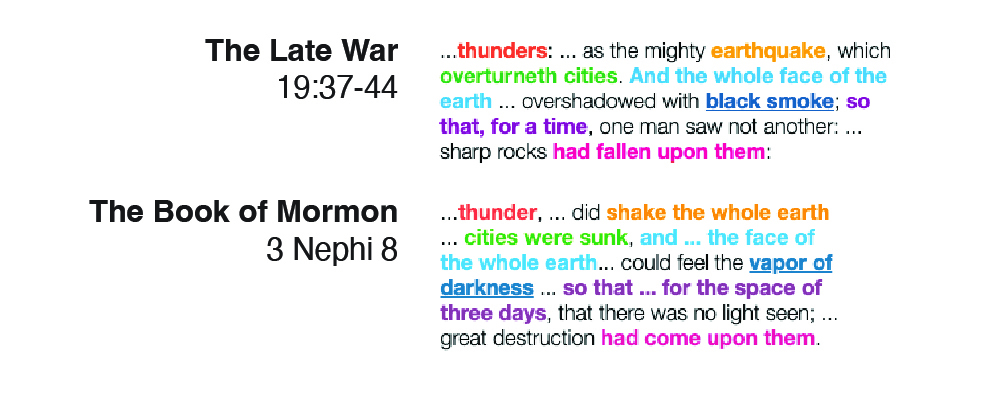
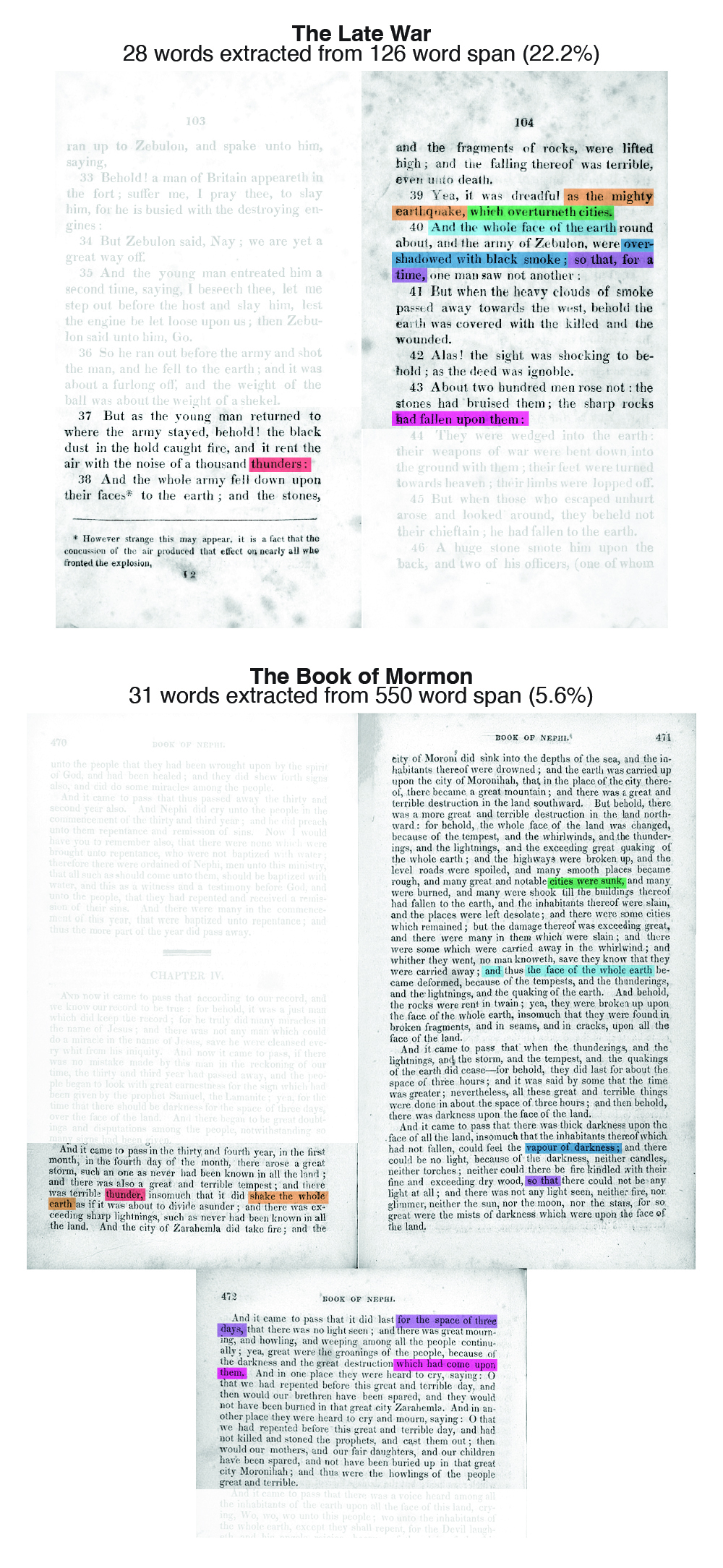
Aren't there a lot of similarities between The Late War and the Book of Mormon?
No, but they do share a similar King James Bible writing style.[102] The Late War is a book about the War of 1812, and critics have claimed that it influenced the Book of Mormon's content.[103] Others have responded that the similarities between the two books are unremarkable.[104]
Some have argued that the language in the Book of Mormon is more genuinely archaic than the pseudo-biblical style of The Late War.[105]
Are there similarities between the Book of Mormon and The First Book of Napoleon?
No. The First Book of Napoleon, the Tyrant of the Earth is a book about Napoleon Bonaparte and European wars.[106] Similar to The Late War, it imitates the language of the King James Bible, and critics have claimed that it influenced the Book of Mormon.[107] There are no strong connections between the two books, and alleged similarities appear to be weak.[108]
Did Joseph Smith take the names “Moroni” and “Cumorah” from the stories of Captain Kidd?
No, probably not. Several people claimed that young Joseph had been interested in the stories and buried treasure of Captain William Kidd.[BIO][109][110] Neither name is mentioned in any known Kidd stories from Joseph's lifetime.[111] Theories that Joseph Smith took the name "Moroni" from other sources are speculative.[112]
Related Question
Was Joseph Smith obsessed with buried treasure?
Read more in Joseph Smith and Fraud Allegations
But weren’t there maps that included the island of “Camora”? And its capital “Moroni”?
Yes, sort of. The Comoros Islands appear on many maps in the 1700s and 1800s, usually referred to as “Comoro” or something similar.[113] “Meroni” appears on two French maps of the Comoros Islands from the 1740s, on the island of Anjouan.[114] The first known appearance of “Moroni” on a map is from 1851 on the island of Ngazidja, which became the capital of the Comoros Islands in 1963.[115]
There is no evidence that Joseph ever saw these maps, and it's unlikely that he did.[116] “Moroni/Meroni” and “Cumorah/Comoro” are examples of false cognates: words that are “similar in form or sound” but have different meanings and origins.[117]
Examples of False Cognates
Examples of False Cognates in the Book of Mormon
Name/Word: | Use in Book of Mormon: | Other Use: |
Antiparah/Antiparras | Nephite city[121] | Spanish word for "glasses"/"goggles"[122] |
Chemish | Nephite, son of Omni[123] | Village in Bulgaria[124] |
Hearthom/Hearthome | Jaredite king, son of Lib[125] | City in Pokémon[126] |
Himni | Nephite missionary, son of Mosiah[127] | Albanian word for "anthem"[128] |
Kimnor/Kimnori | Jaredite, father of Akish[129] | Brand of seaweed snacks[130] |
Manti | Land and city south of Zarahemla[131] | Dumpling in central Asia[132] |
Muloki/Moloka‘i | Missionary, imprisoned by Lamanites[133] | Hawai’ian island[134] |
Neum | Ancient Israelite mentioned by Nephi[135] | Town in Bosnia and Herzegovina[136] |
Ogath | Place south of the waters of Ripliancum[137] | Character in World of Warcraft[138] |
Pachus/Pachas | King of Nephite dissenters[139] | Spanish word for "bottles"[140] |
Shule | Jaredite king, son of Kib[141] | Former kingdom and current county in China[142] |
Zoram | Israelite, travels with Lehi’s family[143] | Political movement in India[144] |
Are the names in the Book of Mormon taken from New England towns?
No, probably not. In 1989, Vernal Holley[BIO] claimed that Solomon Spaulding used names of places in New England and Canada in his unpublished manuscript.[145] However, many of the alleged shared names were not used in or before 1829, and the map does not appear to align with the internal geography of the Book of Mormon.[146]
Didn’t Hyrum Smith go to Dartmouth? Could he have written the Book of Mormon?
No. Hyrum Smith[BIO] did not attend Dartmouth,[147] and he was not present for most of the translation process.[148] Hyrum attended Moor's Indian Charity School, located next to Dartmouth College, where he received a few years of basic education as a teenager.[149]
There is no evidence that Hyrum was involved in the translation of the Book of Mormon.
Did the Dartmouth professor John Smith help produce the Book of Mormon?
No. John Smith[BIO] was a preacher and professor of classical languages at Dartmouth College.[150] He died in 1809, years before Hyrum attended Moor’s Charity School.[151] There is no evidence that Hyrum ever met John Smith, and they appear to be unrelated.[152]
What about Joseph’s parents? Wasn’t his father a school teacher?
Yes, Joseph Smith Sr.[BIO] taught school in the winter when the family farmed in Vermont, a common practice at the time.[153] At the time, no formal education, licensing, or training was required to be a school teacher.[154]
Some critics claimed that Joseph's parents were intelligent and even "cunning,"[155] while other critics said the Smiths were "unlearned," "illiterate," and "superstitious."[156] There is no evidence that Joseph's parents were involved in producing the Book of Mormon.
Related Question
Did Joseph have educated family and friends around him while growing up?
Read more in Joseph Smith's Pre-1830 Education
Did the Book of Mormon come from the devil?
No. The Book of Mormon teaches that Jesus Christ is the resurrected Savior of the world, the Son of God, and the God of the whole earth.[157][158] While some Christians suggest it is satanic or demonic,[159] Latter-day Saints believe the Book of Mormon is the word of God and has divine origins.[160]
Galatians 1:8 warns of angels giving false gospels, didn’t Joseph Smith get the plates from an angel?
Yes. Joseph said the angel Moroni appeared to him and showed him where to get the gold plates.[161] In Galatians, Paul warns against accepting any gospel that isn’t Christ’s, even if it comes from an angel.[162] This warning is against false gospels,[163] not angels in general.[164]
Latter-day Saints believe that the Book of Mormon contains the original gospel taught by Jesus Christ, not a new one.[165] Moroni has been interpreted as the angel referenced in Revelation 14:6[166] who had “the everlasting gospel to preach” to the world.[167][168]
Doesn’t 2 Corinthians 11:14 say that Satan can appear as an angel of light?
Yes.[169] According to Joseph, Satan had appeared as an angel of light at some point, but was detected by Michael the archangel.[170]
On several occasions Joseph gave instructions on how to detect Satan and false spirits.[171][172][173][174]
Did Joseph Smith have a mental illness? Could that have helped him write the Book of Mormon?
No, probably not. There is no historical evidence that Joseph Smith had a mental illness.[175]
Critics have suggested that Joseph had epilepsy,[176] bipolar disorder,[177] dissociative disorder,[178] schizophrenia,[179] and other mental conditions.[180] Studies show that conditions like bipolar disorder and schizophrenia may lead to increased creativity,[181] but also decreased mental cognition.[182] It is unlikely that Joseph Smith had these conditions.[183][184]
Additionally, some scholars have cautioned that diagnosing deceased people, known as "retrospective diagnosis," is an "inadmissible simplification."[185][186]
Was Joseph Smith using hallucinogens during the creation of the Book of Mormon?
No, probably not. An article in the Journal of Psychedelic Studies speculated that Joseph Smith's spiritual experiences and visions were caused by hallucinogens.[187] There is no historical evidence to support the idea that Joseph or early Saints used hallucinogens.[188]
Did Joseph Smith use spiritualism or automatic writing to write the Book of Mormon?
No, probably not. Automatic writing is a spiritualist practice of subconsciously writing in a hypnotic, trance-like state.[189] Some have claimed that the Book of Mormon matches automatic writing texts.[190] Latter-day Saint scholars argue that automatic writing does not sufficiently account for the complex content in the Book of Mormon, nor its details related to ancient travel, naming, and culture.[191][192]
What about the Book of Mormon's similarities to Walt Whitman's Leaves of Grass?
Latter-day Saint apologist Jeff Lindsay[BIO] satirically argued that Joseph Smith plagiarized Walt Whitman's book Leaves of Grass, published in 1855, to show how weak the arguments for plagiarism are.[193]
What are the strengths and weaknesses of the theories?
Theory: | Strengths | Weaknesses |
Joseph Smith created the Book of Mormon himself | The Book of Mormon addresses issues of Joseph's time[194] The Book of Mormon quotes from the King James Bible[195][196] | Joseph’s lack of education and writing abilities[197][198][199] Speed of the translation process[200][201] No drafts or notes predate the original dictated manuscript[202] The Book of Mormon appears to contain information that Joseph Smith could not have known[203] |
Sidney Rigdon used Solomon Spaulding's Manuscript Found | Rigdon and Spaulding both lived in Pittsburgh, Pennsylvania for a time[204] Affidavits from Spaulding's acquaintances claimed Manuscript Found matched the Book of Mormon[205] | No evidence that Sidney Rigdon ever met Solomon Spaulding[206] No evidence that Joseph Smith met Sidney Rigdon before 1830[207] Manuscript Found and the Book of Mormon have little in common[208] Discovery of Manuscript Found shows the affidavits are not reliable[209] No evidence for two Spaulding manuscripts[210] |
Joseph Smith/Solomon Spaulding took names of cities in New England | Claim that Book of Mormon names are similar to New England cities[211] | Many names on the map came into common use after the Book of Mormon was published[212] |
Joseph Smith and Oliver Cowdery used Ethan Smith's View of the Hebrews | View of the Hebrews and the Book of Mormon have parallels, like Israelites in America[213] Oliver Cowdery lived in the same city as Ethan Smith[214] | No evidence that Joseph Smith or Oliver Cowdery read or had access to View of the Hebrews[215] Few strong connections between the two books[216] Latter-day Saints saw View of the Hebrews as evidence for the Book of Mormon[217] Claim arose very late despite View of the Hebrews circulating widely in the 1820s[218][219] Joseph Smith had begun translating the Book of Mormon before Oliver Cowdery was involved[220] |
Joseph Smith used spiritualism or automatic writing | Automatic writers may be able to repeat information they do not consciously remember[221] Joseph Smith's similarities to Pearl Curran, an uneducated spiritualist who produced an acclaimed text through automatic writing[222][223] | Claim that the Book of Mormon contains content that Joseph Smith could not have encountered before dictating it, unlike automatic writing texts[224] |
Hyrum Smith wrote the Book of Mormon | Hyrum attended school near Dartmouth professor John Smith[225] | Hyrum attended Moor's Charity School, not Dartmouth College[226] Hyrum took basic classes like arithmetic[227] Hyrum is not related to Dartmouth professor John Smith, who died before Hyrum was at Moor's[228] Hyrum was not present for most of the translation process[229] |
Joseph Smith used The Late War | Both books use Biblical language and have similar phrases[230] | Alleged textual similarities are weak[231] Book of Mormon grammar is more genuinely archaic than The Late War[232] Claim uses unreliable stylometric analysis that has produced conflicting results[233] Claim arose very late[234] |
Joseph Smith used The First Book of Napoleon | Both books use Biblical language and have similar phrases[235] | Alleged textual similarities are weak[236] Book of Mormon grammar is more genuinely archaic than The First Book of Napoleon[237] Claim arose very late[238] |
Joseph Smith took the names Cumorah and Moroni from Captain Kidd stories or old maps | Prominence of stories about Captain Kidd at the time[239] Repeated claims that Joseph was fascinated by Captain Kidd's lost treasure[240][241] Similarities between the names Moroni/Cumorah and Meroni/Comore[242] | No known Captain Kidd stories during Joseph Smith's lifetime mention Cumorah or Moroni.[243] No evidence Joseph Smith saw maps of Comoros, or its later capital, Moroni[244] Similar words or names may be false cognates[245] Alleged influence on two names does not account for the rest of the Book of Mormon text |
Joseph Smith had a mental illness | Claim that Joseph's family had a history of mental illness[246] Claim that Joseph had symptoms of mental illnesses[247][248] | Difficulties with retrospective diagnosis[249] Lack of contemporary claims or descriptions of Joseph having an illness[250] |
Joseph Smith used hallucinogens | Extensive research into side effects of hallucinogens from retired academics[253] | No historical evidence that Joseph Smith used drugs or hallucinogens[254] No contemporary statements mention hallucinogens or drugs, even from critics[255] Claim is speculative[256] |
Does disproving critical theories prove that the Book of Mormon is true?
No, disproving critical claims and alternative theories does not prove that the Book of Mormon is true.[257]
But is the Book of Mormon true?
Yes.[258]
- Jake T.
“I think the biggest argument for the Book of Mormon is what does it invite us to do? It invites us to follow Christ! Why do so many oppose a book that simply invites us to "Come unto Christ"?”
